7 Visual Marketing Tips for Rural Properties and Large Land Listings
How to capture the scale and serenity of acreage to attract high-value buyers
The Unique Challenge of Marketing the Great Outdoors
Let’s be honest: selling a three-bedroom ranch in the suburbs is a walk in the park compared to selling fifty acres of undeveloped timberland or a working cattle farm. When you’re dealing with a residential listing, you’re selling a kitchen, a master suite, and maybe a nice deck. When you’re selling a rural property, you’re selling a dream of freedom, a specific lifestyle, and often, a significant investment in the earth itself.
The problem? A standard ground-level photo of a field often looks like... well, just a field. Without the right visual strategy, that breathtaking panoramic view or that strategically located creek gets lost in a sea of green and brown pixels. If you want to grab the attention of a buyer looking for their forever homestead or a developer hunting for their next project, you have to change your lens—literally and figuratively. Here are seven visual marketing tips to help you master the art of the large land listing.
1. Leverage the Power of High-Altitude Drone Photography
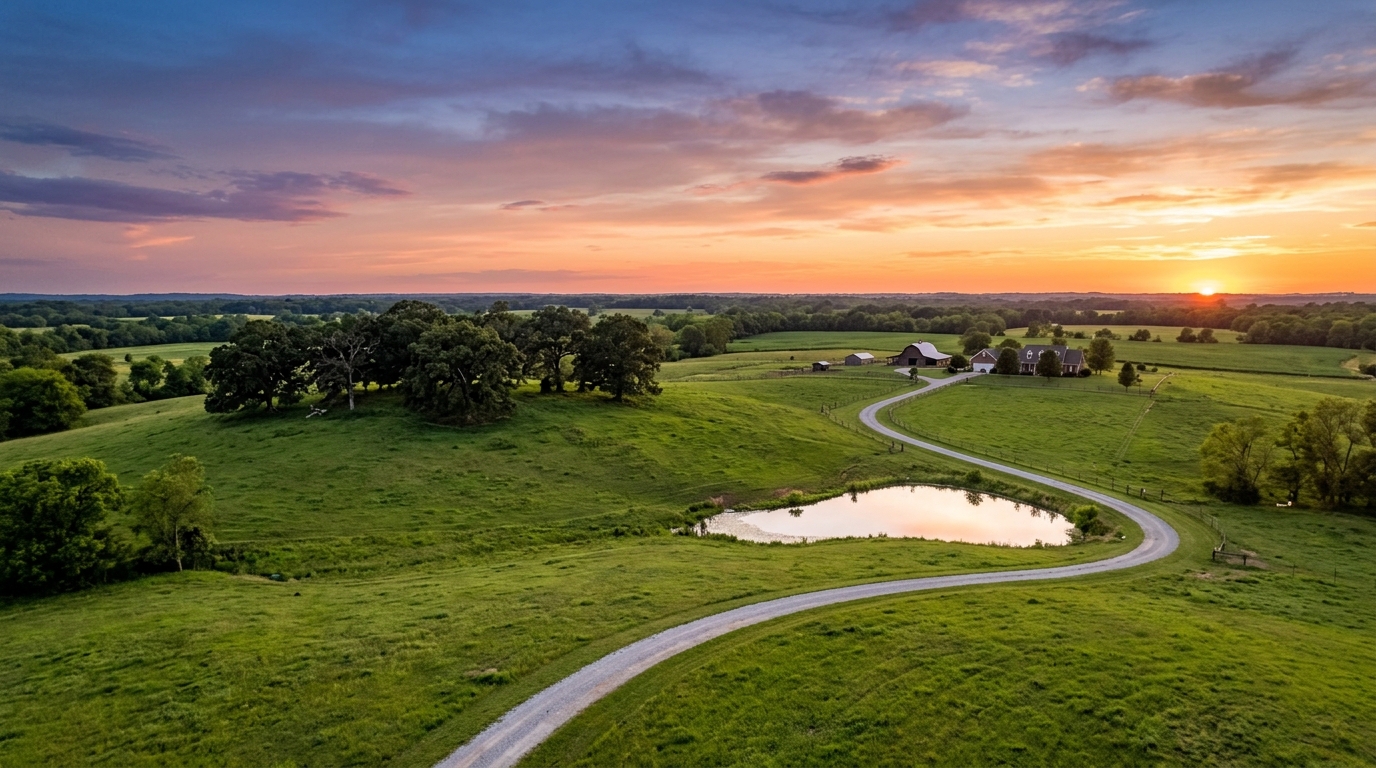
If there is one non-negotiable in rural real estate, it’s aerial imagery. You simply cannot communicate the value of a 20-acre plot from the driver’s seat of a truck. Buyers need to see how the land sits in relation to its neighbors, where the tree line begins, and how the topography rolls. Drone photography provides a sense of scale that ground-level shots can’t hope to match.
When hiring a professional or flying yourself, don't just take one shot from 400 feet up. You need a mix of angles. Capture the 'God’s eye view' (directly top-down) to show the shape of the parcel, but also include low-angle aerials that show the horizon. This helps the buyer visualize what they would see from their future front porch. For more technical advice on this, check out our guide on 7 Drone Photography Tips to Capture High-End Property Angles.
2. Use Graphic Overlays to Define Boundaries
Have you ever scrolled through a land listing and thought, 'Is that the property, or is that the neighbor's woods?' It’s a common frustration for buyers. One of the most effective visual marketing tips for rural properties is the use of boundary overlays. By taking your drone shots and adding a clean, semi-transparent colored line or a 'glowing' border around the parcel, you remove all the guesswork.
This is about more than just clarity; it’s about perceived value. When a buyer sees a defined boundary, the land feels like a 'product' rather than just an undifferentiated piece of the earth. You can also use these overlays to highlight internal features, such as existing trails, building envelopes, or the location of a hidden pond. It turns a pretty picture into a functional map that aids the buying decision.
3. Showcase Infrastructure and 'The Boring Stuff'
In a suburban home, we take for granted that there’s a sewer line and a power connection. In the rural market, those things are gold. Don’t make the mistake of only taking photos of the pretty sunsets. If the property has a high-quality well head, a new septic system, or a power pole already dropped at the build site, take a professional photo of it.
Is there a well-maintained gravel road leading into the property? Photograph it. Is there a sturdy perimeter fence or a gated entrance? Those are high-value assets. Buyers looking for land are often terrified of 'hidden costs.' By visually proving that some of the heavy lifting (infrastructure) is already done, you lower their barrier to entry and make the listing much more attractive. You can even use these photos to help justify your full commission by showing how much detail you’ve put into the presentation.
4. Sell the Lifestyle, Not Just the Soil
Why is someone buying this land? Are they looking to hunt? To start an organic farm? To build a secluded getaway? Your visuals should answer those questions. If the property has a stream, don't just take a photo of the water; take a photo that shows the potential for fishing or the sound of the ripples. If there are deer tracks or a specific clearing perfect for a food plot, document it.
Think about 'staging' the land. Much like you would stage a home, you can stage the outdoor experience. This might mean including a photo of a fire pit at dusk or a well-placed Adirondack chair looking out over a valley. If the property has a porch or a patio, make sure it looks inviting. For inspiration on this, read our tips on staging outdoor living areas to sell the backyard dream. You want the buyer to see themselves living there, not just owning it.
5. Highlight Seasonal Versatility
Rural properties change their personality with the seasons. A property that looks lush and private in July might feel exposed and barren in January. If you have the luxury of time, try to include photos from different seasons. If you're listing in the winter, see if the owners have any high-resolution photos of the property when the wildflowers were blooming or the fall colors were peaking.
If you don't have those photos, use your description and perhaps some 'virtual seasonal editing' to help buyers visualize the year-round beauty. Mentioning the specific types of trees (like Maples for fall color or Evergreens for winter privacy) adds a layer of expertise that land buyers deeply appreciate. It shows you aren't just selling a lot; you're selling a four-season experience.
6. Utilize Virtual Staging for 'Blank Canvas' Listings
One of the hardest things for a land buyer to do is visualize a house on a flat, empty field. Where would the driveway go? How would the house sit to catch the sun? This is where virtual staging becomes a game-changer. You can take a high-quality drone shot of a buildable site and have a digital artist 'place' a beautiful farmhouse or a modern cabin on it.
This doesn't just sell the land; it sells the potential. It helps the buyer overcome the 'analysis paralysis' that often comes with raw land. Just be sure to label these images clearly as 'artist renderings' or 'virtual concepts.' To learn more about the pros and cons of this approach, take a look at our breakdown of virtual staging versus physical staging.
7. Capture the 'Blue Hour' and Twilight Atmosphere
We often talk about twilight photography for luxury mansions, but it is equally—if not more—effective for rural land. There is a specific kind of magic that happens in the country when the sun goes down. The sky turns a deep violet, the stars begin to peek out, and the silence of the land almost becomes visible.
A twilight shot of a rural listing creates an emotional 'hook' that a midday sun shot simply can't. It evokes feelings of peace, solitude, and escape. If there is a small cabin or even just a shed on the property, turn the lights on inside to create a warm, golden glow against the blue evening sky. It transforms the property from a 'piece of real estate' into a 'sanctuary.'
Conclusion: Turning Dirt into a Destination
Marketing rural properties and large land listings requires a shift in perspective. You aren't just selling square footage; you're selling acreage, potential, and a break from the noise of modern life. By using drones to show scale, overlays to show boundaries, and lifestyle shots to show the 'why,' you create a compelling narrative that resonates with buyers on an emotional level.
Remember, land buyers are often more analytical and more visionary than the average home buyer. They need the data (boundaries and infrastructure) and the dream (twilight shots and lifestyle visuals). When you provide both, you don't just get a click—you get a showing. Ready to elevate your next land listing? Start by looking up, and don't be afraid to show the world exactly where that property line ends and the adventure begins.