How to Stage a Home Office to Attract Modern Remote Workers
Turn that spare bedroom into a high-value productivity hub that closes deals.
The New Most Important Room in the House
Remember when a home office was just a dusty desk tucked into a corner of the guest room? Those days are long gone. For the modern buyer, a dedicated workspace isn't just a 'nice-to-have'—it’s a non-negotiable requirement. Whether they’re a full-time remote software engineer or a hybrid marketing executive, today's professionals are looking for a space that says 'productivity' rather than 'overflow storage.'
If you're listing a property in this market, you have to realize that the home office has become the new kitchen. It’s a high-value room that can either make a buyer fall in love or walk away because they can't imagine where they’ll take their 9:00 AM Zoom call. So, how do you stage a home office to attract these modern remote workers? It’s about more than just a chair and a desk; it’s about selling a lifestyle of professional success and work-life balance.
1. Master the 'Zoom Background'
Let’s talk about the 'Zoom Wall.' We’ve all been on those calls where the person on the other end has a pile of laundry or a distracting, cluttered bookshelf behind them. Buyers are subconsciously scanning the room to see where they would sit and what their colleagues would see. When you stage the office, the wall directly behind the desk is your most valuable real estate.
Keep it clean, but don't make it sterile. A tasteful piece of abstract art, a few well-placed (and organized) books, or a high-quality plant can add texture without being distracting. Think about Using Emotional Visual Triggers in Real Estate Marketing to create a sense of calm and competence. A symmetrical layout often reads better on camera, so consider centering the desk against a feature wall or between two windows.
2. Prioritize Natural Light and Strategic Lighting
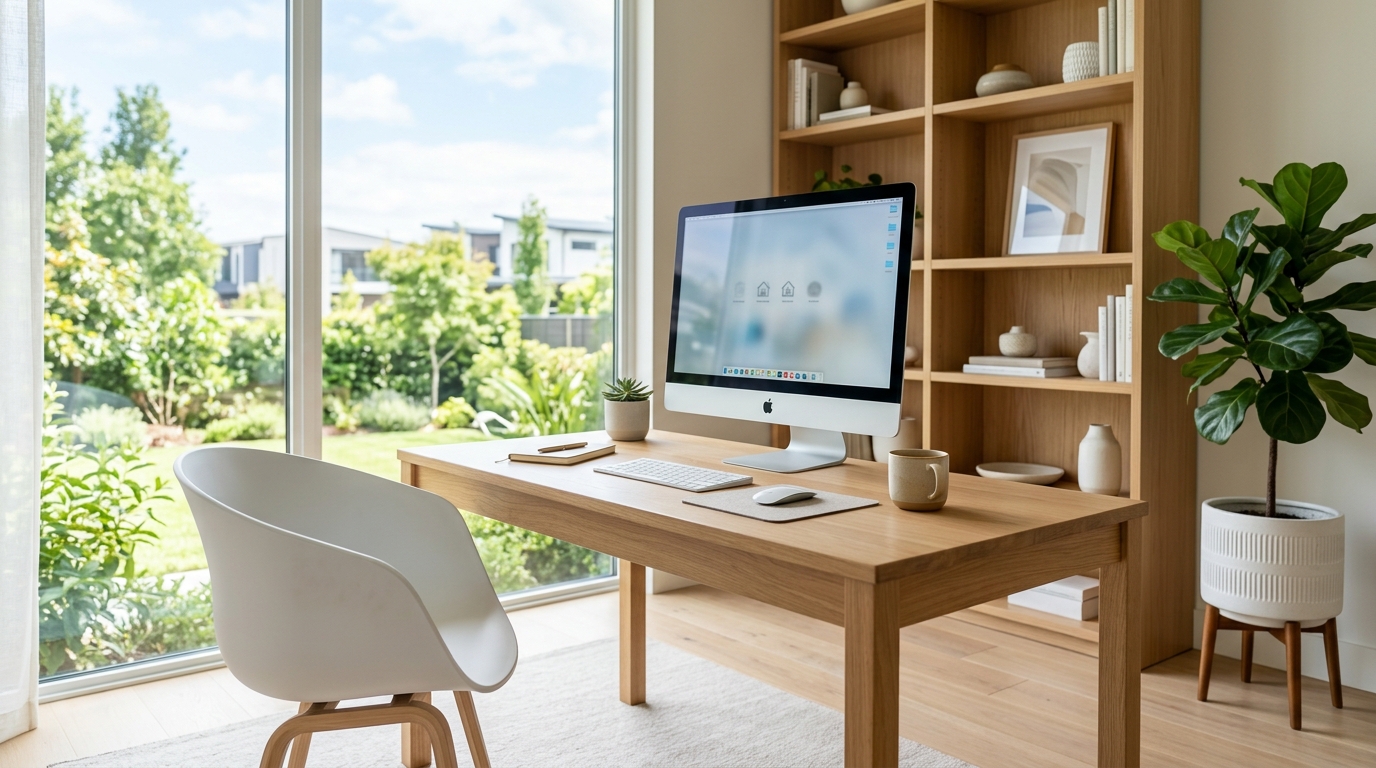
Nothing kills the vibe of a home office faster than a flickering overhead fluorescent light or a dark, cave-like atmosphere. Remote workers spend 8–10 hours a day in this space; they want to feel energized, not drained. If the room has a window, make it the star of the show. Position the desk so the light hits the worker's face (front-lit) rather than their back, which prevents that dreaded silhouette effect on video calls.
In rooms with less-than-ideal window placement, you'll need to supplement. Use a mix of task lighting (a sleek desk lamp) and ambient lighting (a floor lamp in a corner). If the home is equipped with smart lighting, make sure to highlight it. As we mention in our guide on How to Market a Smart Home: Highlighting Tech for Modern Buyers, showing off app-controlled lighting that can shift from 'focus mode' to 'relax mode' is a massive selling point for tech-savvy professionals.
3. Scale the Furniture to the Space
One of the biggest mistakes agents make is cramming a massive, old-fashioned executive desk into a small spare bedroom. It makes the room feel cramped and outdated. Modern remote workers typically prefer 'airy' and 'minimalist' over 'heavy' and 'traditional.'
Use a desk with slim legs—something that allows you to see the floor underneath. This trick creates the illusion of more square footage. If you're working with a particularly tight area, check out our tips on How to Photograph Small Spaces: Tips to Make Rooms Look Big. A floating desk or a ladder desk can show buyers that even a small nook can be a functional, high-output workspace.
Quick Staging Checklist for Office Furniture:
- The Desk: Clean lines, no scratches, and absolutely no tangled wires visible.
- The Chair: Avoid the bulky 'gaming' chairs. Opt for a sleek, ergonomic task chair in a neutral tone.
- The Rug: A low-pile rug helps define the space and provides acoustic dampening for those all-day meetings.
4. Show Off the Tech Potential
A modern remote worker isn't just looking at the walls; they’re looking for outlets. While you don't need to plug in a full server rack, you should hint at the home's connectivity. Use 'dummy' tech like a sleek monitor, a wireless keyboard, and a mouse to help the buyer visualize their setup.
Hide all the cords! Nothing ruins the aesthetic of a staged room like a 'cable nest' under the desk. Use zip ties or cable management boxes to keep everything tucked away. If the house has high-speed fiber or mesh Wi-Fi nodes, place those nodes discretely in the room to signal that 'dead zones' won't be an issue here.
5. Define the 'Flex' in Flex-Space
Sometimes, a house doesn't have a dedicated room for an office. In this case, you have to get creative with staging a 'Cloffice' (closet office) or a landing area. The key here is intentionality. If you just put a chair in a hallway, it looks like a mistake. If you put a small desk, a lamp, and a notepad there, it looks like a curated 'work-from-home' nook.
For listings where a bedroom must serve double duty, use a small desk as a nightstand. This shows the buyer that the room is versatile enough to handle a bed and a laptop without feeling like a dorm room. It’s about solving the buyer's problem before they even have to ask, 'Where would I work?'
6. Add Greenery for Focus and Air Quality
Plants aren't just for decor; they are psychological cues for health and focus. A Snake Plant or a Fiddle Leaf Fig can breathe life into a static office setup. It adds a pop of color that looks fantastic in listing photos and makes the air feel fresher during an open house. Plus, it’s a great way to soften the hard edges of desks and monitors.
Conclusion: Selling the Dream of Productivity
Staging a home office is about more than just filling a room; it’s about illustrating a lifestyle where work is seamless and the environment is inspiring. When a buyer walks into a well-staged office, they shouldn't just see a room—they should see their future promotions, their creative breakthroughs, and their stress-free Monday mornings.
By focusing on lighting, the 'Zoom-ready' aesthetic, and smart furniture choices, you turn a simple room into a major selling feature that justifies a higher asking price. Ready to take your listing visuals to the next level? Don't forget that how you capture these spaces is just as important as how you stage them!