How to Stage a Finished Basement: 7 Tips to Add Real Living Value
Transform your lower level from a storage catch-all into a high-value living space that closes deals.
The Forgotten Square Footage: Why Basement Staging Matters
Let’s be honest: for many homeowners, the basement is where design dreams go to die. It’s the land of mismatched sofas, holiday decor bins, and that treadmill that’s been serving as a clothes rack since 2018. But as a real estate professional, you know that a finished basement is one of the most powerful tools in your arsenal. It’s the 'bonus' that can justify a higher asking price and tip the scales for a hesitant buyer.
When you learn how to stage a finished basement properly, you aren't just cleaning up a room; you're redefining the home's total livable square footage. Buyers don't want to see a 'nice basement.' They want to see a high-end media room, a quiet guest suite, or the ultimate home gym. If the space feels like a dungeon, they won't count it as true living space. If it feels like a natural extension of the upstairs, you've just added massive perceived value.
Ready to turn that lower level into a high-value asset? Here are seven actionable tips to stage a finished basement for maximum impact.
1. Define Clear Functional Zones
The biggest mistake in basement staging is leaving the floor plan ambiguous. Large, open basements often confuse buyers. They stand at the bottom of the stairs and think, 'What would I even do with all this?'
You need to answer that question for them by 'zoning' the space. Use area rugs, furniture groupings, and lighting to create distinct 'rooms' within the open area. For example, you might set up one corner as a cozy reading nook, the central area as a family media room, and a small alcove as a craft station or home office. By creating these vignettes, you help the buyer visualize their own life unfolding in the space.
2. Master the Art of Artificial Lighting
Basements are notoriously light-starved. Even 'walk-out' basements usually have one side that feels a bit subterranean. To combat the 'cave' vibe, you need to over-index on lighting. Don't rely on a single overhead fluorescent fixture.
Layer your lighting with a mix of three types:
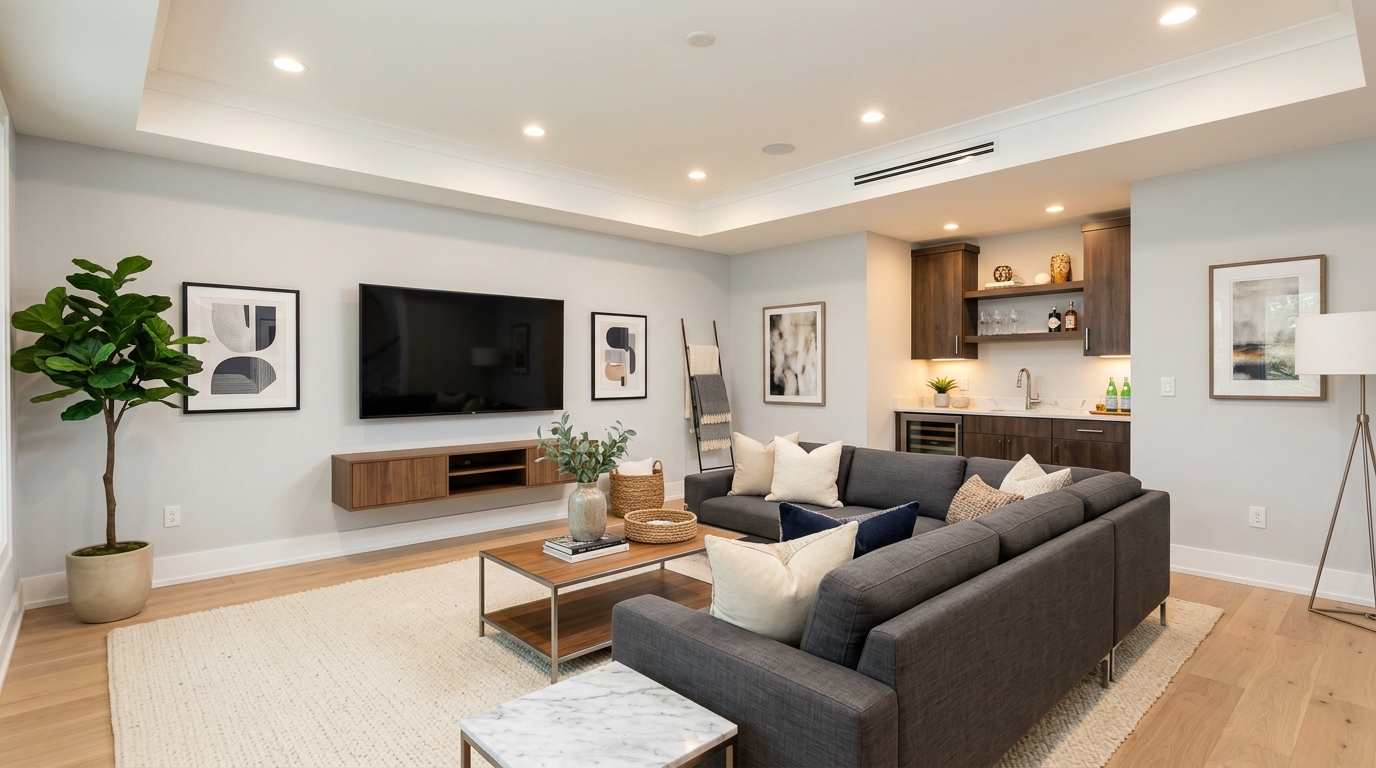
- Ambient: Recessed 'can' lights or flush mounts for general visibility.
- Task: Desk lamps in office zones or under-cabinet lighting if there’s a wet bar.
- Accent: Warm floor lamps or LED strips behind a TV to create depth.
Pro tip: Swap out old bulbs for 'Daylight' or 'Cool White' LEDs (around 3000K-4000K). This mimics natural light and makes the space feel more energetic and less like a storage cellar. If you're looking for more ways to enhance the visual appeal of smaller or darker areas, check out our guide on how to stage small spaces for more depth-defying tricks.
3. Use Color Psychology to Brighten and Warm
Color choice in a basement is high stakes. Dark colors can make a basement feel sophisticated in a 'speakeasy' way, but for general resale, they often make the space feel cramped and gloomy. Stick to a palette that reflects light rather than absorbing it.
Soft whites, warm greys, and light beiges are your best friends here. However, don't be afraid to use a 'pop' of color in your accessories to keep the room from looking sterile. Using a soft navy or a sage green in throw pillows can ground the space. We’ve found that using color psychology effectively can actually speed up the sale by making buyers feel more emotionally 'at home' the moment they walk in.
4. Scale Furniture for Lower Ceilings
Basement ceilings are often lower than those on the main floor, sometimes with low-hanging ductwork or bulkheads. If you put massive, overstuffed sectionals in a room with seven-foot ceilings, the space will feel suffocating.
Choose 'low-profile' furniture. Look for sofas with lower backs and chairs with exposed legs. Seeing the floor underneath the furniture creates an illusion of more space. Also, avoid heavy, dark wood coffee tables. Glass or acrylic tables 'disappear' in a room, making the footprint feel larger than it is. The goal is to make the basement feel airy, not cluttered.
5. Address the Sensory Experience (Air and Sound)
You can’t see air quality in a photo, but a buyer will certainly smell it during a showing. Basements are prone to that 'musty' smell. Before any staging begins, ensure the space is dehumidified and well-ventilated. A high-quality air purifier can work wonders for neutralizing odors.
Sound is the other sensory factor. Basements can be echoey, especially if they have LVP (Luxury Vinyl Plank) or tile floors. Use plush area rugs and fabric wall hangings to dampen sound. This makes the basement feel 'soft' and quiet, which reinforces the feeling of a high-quality living area rather than a concrete box.
6. Showcase the 'Bonus' Lifestyle Features
What makes this basement special? If there’s a wet bar, don’t leave it empty. Stage it with a high-end coffee maker, a few clean wine glasses, and a bowl of fresh lemons. If there’s a fireplace, make it the focal point of a seating arrangement.
In the current market, 'lifestyle' sells. Many buyers are looking for multi-generational living options or secondary entertainment hubs. If the basement has a separate entrance or a kitchenette, highlight that potential. You’re not just selling a room; you’re selling the idea of a 'man cave,' a 'she-shed,' or a 'teen hangout.' Making these lifestyle connections is key to adding real value.
7. Use Floor Plans to Prove the Layout Works
Sometimes, no matter how well you stage, a basement’s layout can look confusing in 2D photos. Is that a bedroom or a storage room? Where does that hallway lead? This is where professional marketing assets become essential.
Including a floor plan in your listing allows buyers to see exactly how the basement connects to the rest of the home. It clarifies the flow and proves that the 'extra' rooms are functional and legitimate. There are many reasons to add floor plans to your listing strategy, but in a finished basement, it’s specifically about legitimizing the space as part of the total square footage.
The Final Polish: Professional Visuals
Once the staging is set, the lighting is bright, and the 'zones' are established, don't let all that hard work go to waste with amateur photography. Basements are notoriously difficult to photograph because of the lack of natural light and the tight angles. This is where a professional real estate photographer earns their keep, using HDR techniques to balance the artificial light and show the space in its best light.
Remember, your goal is to make the basement feel like a place where the buyer wants to spend their Sunday afternoons. If you can achieve that, you've successfully added thousands of dollars in perceived value to your listing.
Ready to showcase your next listing?
At The Listing Showcase, we specialize in making every inch of a home—from the attic to the finished basement—look like a million dollars. Whether you need high-end photography, 3D tours, or detailed floor plans, we have the tools to help you win more listings and sell them faster. Contact us today to elevate your marketing game.