Mastering Drone Photography for Large Luxury Estates
Elevate Your Marketing Strategy and Capture the Full Scale of High-End Acreage
The Ceiling of Ground-Level Photography
You’ve finally landed that whale—a sprawling 20-acre estate with a guest house, a private lake, and a master suite that’s larger than most starter homes. You’re excited, but then you realize the challenge: how do you fit twenty acres of luxury into a standard 4x6 frame? If you stick to ground-level shots, you’re essentially trying to describe a symphony by only showing the violin. Ground-level photography is great for capturing the texture of a marble countertop or the warmth of a fireplace, but for massive properties, it fails to tell the most important story: the story of scale.
Drone photography has moved from a 'nice-to-have' novelty to a non-negotiable requirement for high-end real estate marketing. When you’re dealing with luxury estates, the value isn’t just in the square footage of the house; it’s in the privacy, the landscaping, the proximity to the coast, and the overall layout. To sell that dream, you need to get airborne. In this guide, we’ll dive deep into how to use drone photography to market large luxury estates effectively and why this perspective is the key to winning high-net-worth clients.
1. Establishing the Sense of Scale and Context
The primary reason drone photography is so effective for luxury estates is its ability to provide immediate context. When a buyer looks at a luxury listing, they aren't just looking for a home; they are looking for an environment. They want to know how the tennis court relates to the pool house, or how far the private dock is from the back porch.
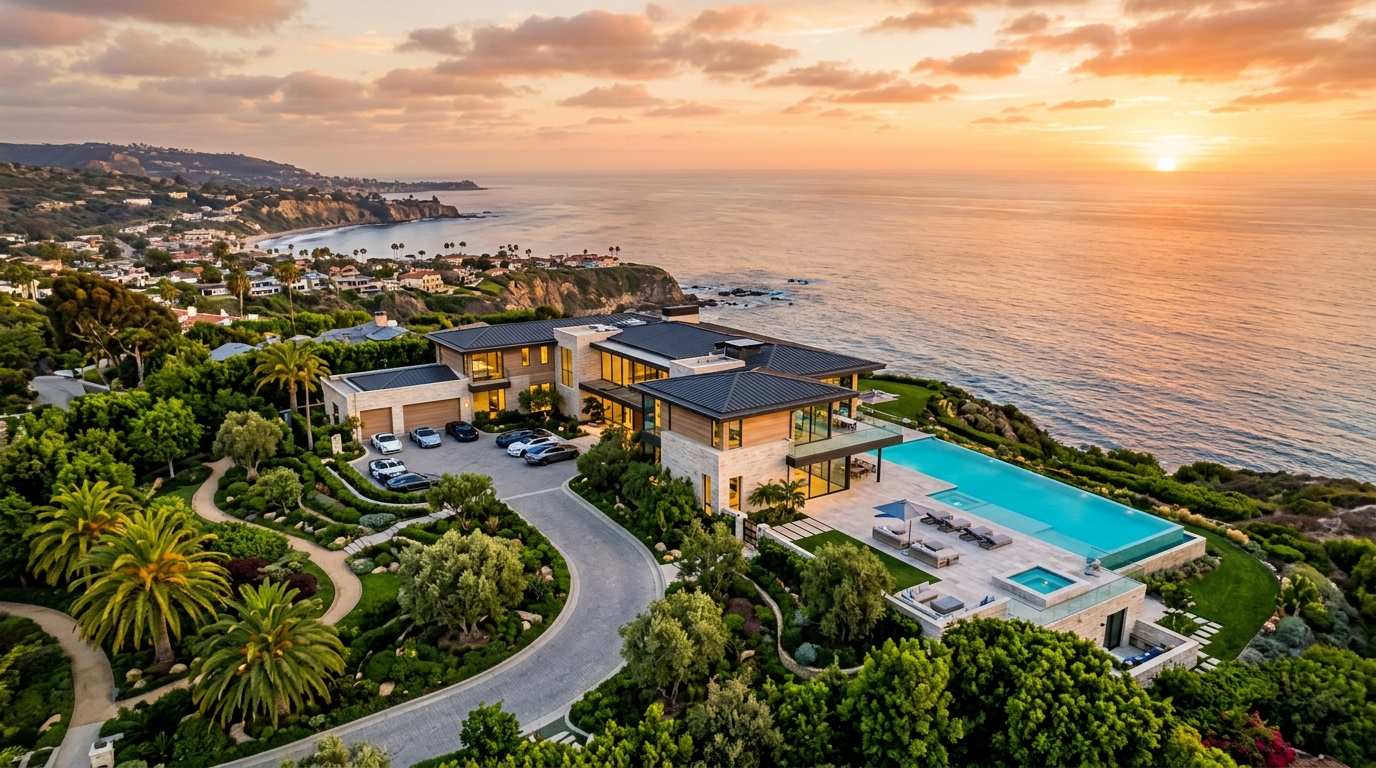
A standard wide-angle lens from the driveway might show a beautiful facade, but a drone shot from 100 feet in the air shows the winding driveway, the manicured gardens, and the surrounding forest that ensures total privacy. This is particularly crucial when you are following visual marketing tips for rural properties and large land listings, where the land itself is the primary asset. By showing the property boundaries from above, you eliminate the guesswork for the buyer. They can see exactly where their kingdom ends and the rest of the world begins.
The 'Hero Shot' vs. The 'Map Shot'
When using a drone, you need two distinct types of photos. The first is the 'Hero Shot'—an angled, cinematic view of the main residence that highlights architectural features while still showing some of the grounds. The second is the 'Map Shot'—a top-down or high-altitude shot that acts as a visual survey of the entire parcel. Both are necessary to justify a luxury price tag.
2. Highlighting Premium Outdoor Amenities
Luxury buyers are often outdoor enthusiasts—or at least, they love the idea of being one. Whether it’s a resort-style pool, a private putting green, or an elaborate outdoor kitchen, these features are often the 'closing' features of a home. However, these amenities are frequently difficult to photograph from the ground because of fences, landscaping, or the sheer size of the features themselves.
Drones allow you to capture the 'lifestyle flow.' Imagine a video clip that starts at the back patio, glides over the infinity-edge pool, and continues down to the private beach. This creates an emotional connection that static photos can't touch. If the property has unique additions, like a guest cottage or a workshop, drone footage is the best way to show how they integrate into the main estate. For more on this, check out our guide on marketing a home with an ADU to see how to highlight those secondary structures effectively.
3. Timing is Everything: The Golden Hour Drone Session
If you think drone photos look good at noon, wait until you see them at sunset. In the luxury market, atmosphere is everything. We often talk about how twilight photography makes listings stand out, and this is doubly true for aerial shots.
When the sun is low on the horizon, the long shadows accentuate the topography of the land. The glow from the interior lights of the mansion creates a warm, inviting contrast against the cooling blue of the evening sky. A drone captured at twilight can show the entire estate 'glowing' in the dark, highlighting the exterior lighting design which is often a multi-thousand-dollar investment in itself. It’s the ultimate 'prestige' shot that makes a listing look like a spread in Architectural Digest.
4. Creating a Narrative with Aerial Video
While still photos are essential for the MLS, video is where you win on social media. For a large estate, a 60-second drone film can act as a virtual tour of the grounds. But don't just fly the drone in a straight line. Use 'cinematic orbits'—where the drone circles a specific feature like a fountain or a turret—to create a sense of three-dimensional depth.
Think of your drone video as a movie trailer for the home. Start with a high-altitude shot to establish the location, then slowly 'descend' into the property's best features. This narrative approach helps out-of-state relocation buyers, who may not be able to visit in person, get a true feel for the property's layout and grandeur. To maximize the impact of these videos, many agents are now featuring them on a single-property website, where the video can play in full-screen high definition without the distractions of a third-party listing site.
5. Navigating the Legal and Professional Landscape
Before you go out and buy a drone to fly over your next $5 million listing, there are a few 'boring' but vital things to consider. In the United States, the FAA requires anyone flying a drone for commercial purposes (which includes real estate marketing) to have a Part 107 Remote Pilot Certificate.
- Insurance is Key: Ensure your photographer has liability insurance. The last thing you want is a drone crashing into a client’s bespoke slate roof or, worse, a neighbor’s window.
- Privacy Concerns: Be mindful of the neighbors. When marketing a luxury estate, privacy is a top priority for the owners and their neighbors. Avoid hovering over adjacent properties or capturing shots that look directly into a neighbor’s windows.
- Weather Restrictions: Drones and wind don't mix. High-end estates near the coast often deal with heavy gusts. Plan your shoot for a day with clear skies and low wind to ensure the smoothest footage possible.
6. Using Drones to Highlight Location and Lifestyle
Luxury isn't just about what's inside the property lines; it's about what's nearby. Is the estate five minutes from a world-class golf course? Is it perched on a cliff overlooking the ocean? A drone can capture the home in the foreground with these local landmarks in the background.
This 'lifestyle' marketing is incredibly powerful. You aren't just selling a 5-bedroom house; you're selling a lifestyle that includes morning rounds of golf or sunset boat rides. Use the drone to show the proximity to the yacht club or the private school down the road. This context justifies the luxury price point by proving the property is situated in a high-value area.
7. Winning the Listing Presentation
Finally, let’s talk about your business. When you show up to a listing presentation for a high-end estate, the seller is looking for a marketing partner who understands the magnitude of their investment. Showing them a portfolio of high-quality drone work—including aerial videos, twilight shots, and boundary-mapped stills—proves that you have the tools to market their home correctly.
It’s a powerful differentiator. While other agents might talk about 'putting it on the MLS,' you can talk about 'creating a cinematic lifestyle film' and 'utilizing aerial mapping to showcase the property’s full acreage.' This level of professionalism is often what tips the scale in your favor, allowing you to secure the listing and justify your commission.
The Bottom Line
Drone photography has revolutionized how we market large luxury estates. It provides a perspective that was once only available to those who could afford to hire a helicopter. By capturing the scale, the amenities, and the surrounding lifestyle, you provide potential buyers with a comprehensive understanding of the property that ground-level photos simply can’t match. Whether you’re selling a sprawling vineyard, a coastal mansion, or a mountain retreat, getting into the air is the best way to make sure your listing—and your brand—reaches new heights.